What Inspectors Expect to See in Fire Damper Asset Registers
Table of Contents
- What Is a Fire Damper Asset Register?
- Why Fire Damper Asset Registers Matter for Compliance
- What Inspectors Expect to See in a Fire Damper Asset Register
- Common Asset Register Mistakes Inspectors Flag
- Digital vs Manual Fire Damper Asset Registers
- Who Is Responsible for the Fire Damper Asset Register?
- How Damper Safe Ltd Supports Compliant Asset Registers
What Is a Fire Damper Asset Register?
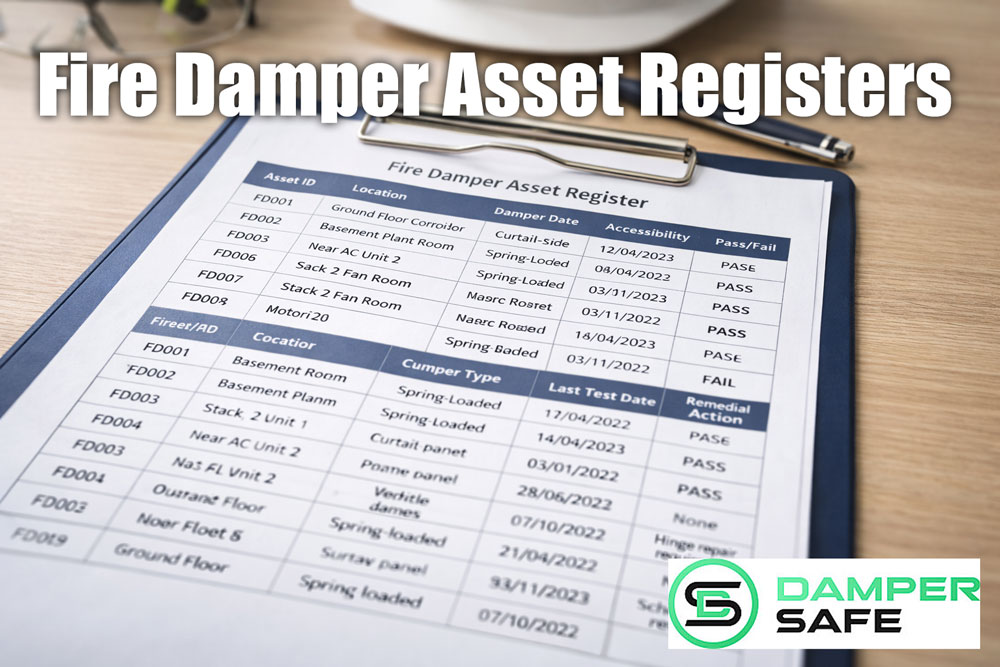 A fire damper asset register is a formal, auditable record of every fire damper installed within a building. It exists to prove that fire dampers are not only present, but known, accessible, tested, and maintained as part of the building’s passive fire protection system.
Unlike a one-off test report, an asset register is a live document that tracks each fire damper throughout its lifecycle — from identification and inspection through to testing, failure, remedial works, and re-certification.
For inspectors, it provides clarity. For duty holders, it provides protection.
Why Fire Damper Asset Registers Matter for Compliance
Under UK fire safety legislation, including the Regulatory Reform (Fire Safety) Order 2005, the Responsible Person must be able to demonstrate compliance with UK fire damper compliance requirements.
This includes evidence that fire dampers have been:
- Correctly identified
- Regularly tested
- Maintained and repaired where necessary
- Recorded accurately and reviewed
Inspectors will often review asset registers alongside broader documentation linked to the latest UK fire safety regulations. If records are missing, outdated, or inconsistent with site conditions, dampers may be treated as non-compliant — even if they physically exist.
What Inspectors Expect to See in a Fire Damper Asset Register
Unique Identification for Every Fire Damper
Each fire damper must have a unique reference ID. Grouped entries or vague listings are not acceptable. Inspectors expect a one-to-one relationship between a physical damper and a register entry.
Precise Location Information
Descriptions such as “above ceiling” are insufficient. Registers should include floor level, room or area reference, and fixed landmarks to ensure the damper can be reliably located again.
Fire Damper Type and Specification
Inspectors expect registers to confirm the damper type, fire rating, activation method, and manufacturer where known. This information supports correct specification in line with recognised fire damper installation standards and helps verify that dampers will perform as intended in a fire scenario.
Understanding how fire dampers work to contain fire and smoke also helps inspectors identify mis-installed or unsuitable units.
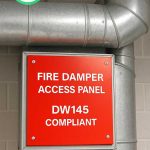
Access Method and Condition
Asset registers must record how each damper is accessed, including the presence and condition of access panels. Dampers that cannot be safely accessed for inspection are commonly recorded as failures.
Testing Frequency and Test History
Registers must show when each damper was last tested, the method used, and who carried out the work. Inspectors will often cross-check this against guidance on how often fire dampers must be tested.
Clear Pass or Fail Status
Each entry must clearly state whether the damper passed or failed. Ambiguous wording such as “checked” or “appears OK” is unlikely to be accepted during an audit.
Recorded Defects and Remedial Actions
Where failures occur, inspectors expect to see a full record of the defect, risk level, and recommended remedial action. Many issues align with known common fire damper failures, such as seized blades, missing components, or poor installation.
Retesting and Re-Certification
After remedial works, registers must show that the damper has been retested and returned to service. A repaired damper without evidence of re-testing is still treated as non-compliant.
Common Asset Register Mistakes Inspectors Flag
Some of the most frequent issues we encounter include:
- Dampers missing from the register entirely
- Locations that no longer match site conditions
- Failed dampers with no recorded follow-up
- Registers not updated after refurbishment works
- Unexpected cost exposure due to poor planning around fire damper testing costs
Digital vs Manual Fire Damper Asset Registers
While paper registers are not prohibited, inspectors increasingly expect structured, legible, and up-to-date records. Digital asset registers make it far easier to track testing history, attach photographic evidence, and support the importance of regular fire damper maintenance, particularly across large or complex sites.
Who Is Responsible for the Fire Damper Asset Register?
The legal responsibility for maintaining an accurate fire damper asset register sits with the Responsible Person. While inspection and testing can be outsourced, accountability cannot.
This responsibility aligns closely with guidance on who is responsible for fire damper testing, and failures in record-keeping are increasingly cited during enforcement action.
How Damper Safe Ltd Supports Compliant Asset Registers
At Damper Safe Ltd, we support clients beyond testing alone. Our services include:
- Full site surveys to identify unrecorded fire dampers
- Asset tagging and register creation
- Clear defect reporting and prioritised remedial planning
- Ongoing register updates following testing and repairs
The result is an asset register that reflects real site conditions and stands up to inspection — not just a document created to tick a box.
Fire damper asset registers are proof of compliance, not paperwork. If an inspector cannot trust your records, they will not trust your system.